

If cardboard boxes are piling up at your home and your curbside recycling service can’t keep up, you’re not alone. Across the country, households are dealing with overflowing bins, missed pickups, and growing confusion about how to manage the flood of packaging from online shopping. What’s often referred to as the “Curbside Cardboard Crisis” goes beyond a simple inconvenience. It highlights serious flaws in our recycling systems, environmental practices, and overall waste management as a society.
We’ve seen firsthand how this issue is impacting residents and neighborhoods. That’s why we created this guide to help you understand what’s driving the crisis, the challenges within the system, the consequences for our planet and economy, and most importantly, the practical solutions available to you today.
Origins of the Cardboard Surge
The explosion in cardboard box removal needs didn’t happen overnight. It’s a byproduct of a digital economy increasingly built around doorstep convenience. E-commerce has skyrocketed in the last decade, with global online sales surpassing $6.3 trillion in 2024. Every online order, be it a bulk grocery haul or a single tube of toothpaste, often arrives in its own box, padded with additional packaging materials.
This shift in consumer behavior is now commonly called the “Amazon effect”, referring to how increased online shopping has reshaped logistics, packaging, and waste generation. Even as the pandemic subsides, shopping habits haven’t gone back to normal. For many, online ordering is now routine, which means residential cardboard volumes remain at record highs.
While some companies have tried to minimize excess packaging, it’s often still more cost-effective for them to ship smaller items in oversized boxes, resulting in more waste. In short, the cardboard surge is a symptom of a culture that prioritizes convenience but has consequences.
Challenges in Curbside Recycling
Recycling cardboard might seem simple, but the real-world process is often messy, inconsistent, and poorly equipped for today’s volume.
Volume Overload
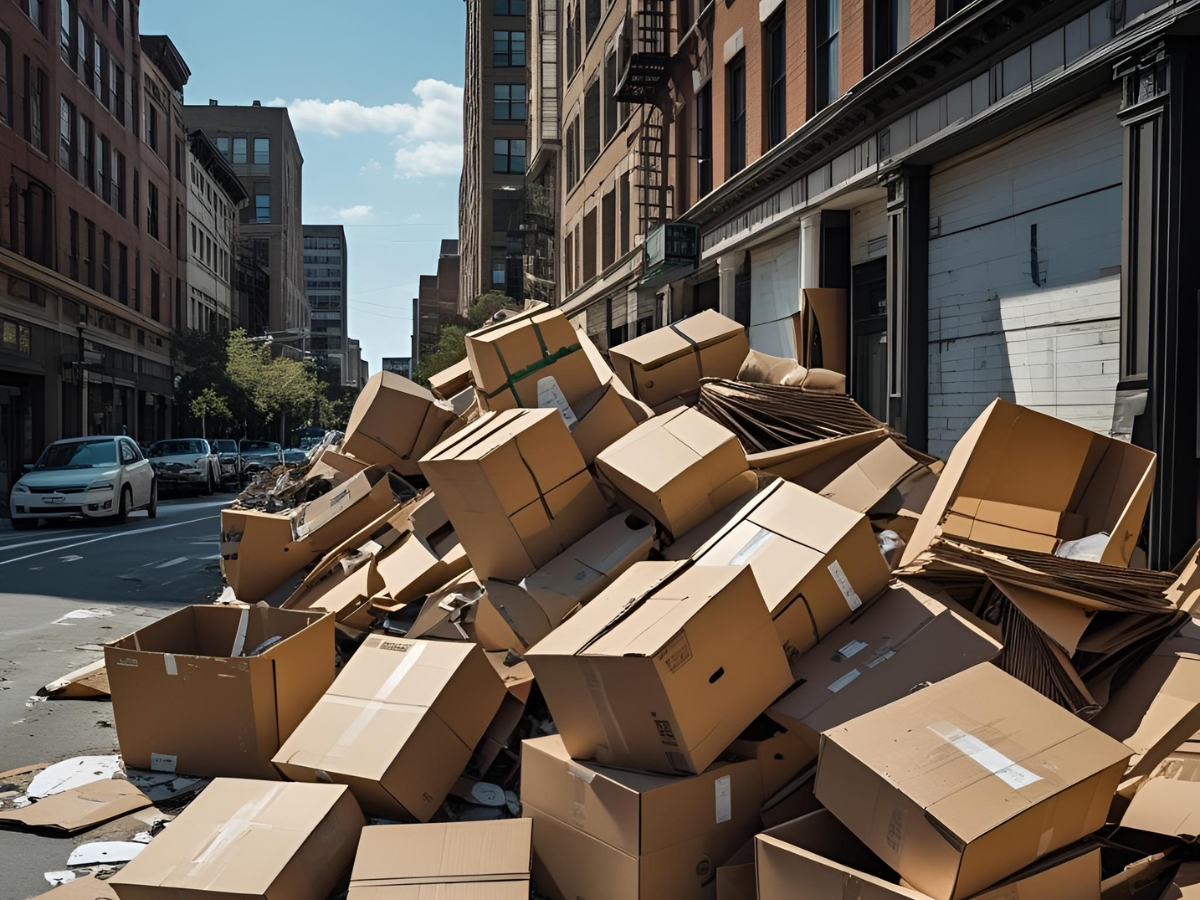
Local curbside cardboard recycling systems were not designed for today’s cardboard-heavy waste stream. Trucks fill up faster, bins overflow before pickup day, and facilities are stretched thin. In many urban areas, it’s not uncommon to see streets lined with stacked boxes waiting to be collected or left behind.
Contamination
For cardboard to be recyclable, it must be clean and dry. A single greasy pizza box or a rain-soaked delivery package can contaminate an entire batch. And because many people don’t realize they need to remove tape, labels, or packing peanuts, improperly prepared cardboard often gets diverted to landfills, complicating cardboard recycling pickup efforts.
Inconsistent Rules
Each city and county has its own recycling rules, what’s accepted, what needs to be flattened, and how clean materials must be, and there’s no national standard. This creates widespread confusion. For example, some programs allow wax-coated cardboard; others don’t. Some require removal of plastic windows; others process them as-is.
Labor and Budget Shortages
Curbside recycling relies on a combination of public funding and private haulers. Many of these programs face staffing shortages, outdated vehicles, or tight budgets, leading to missed pickups and inconsistent service. For residents cleaning out a rental unit or preparing a property for sale, these gaps are often filled by on-demand cleaning and restoration services that specialize in full-property transitions, including debris and trash removal.
All of this contributes to a frustrating consumer experience, leading many people to give up on recycling altogether.
Environmental and Economic Impacts
The curbside cardboard crisis may start at the curb, but its ripple effects are global.
Environmental Consequences
Cardboard, despite being recyclable, still has a significant environmental footprint. Most cardboard is made from virgin wood pulp. With U.S. demand increasing yearly, more trees are harvested, processed, and transported, each step contributing to greenhouse gas emissions.
Improperly disposed cardboard ends up in landfills, where it can generate methane, a greenhouse gas that’s over 25 times more potent than carbon dioxide. Even when recycled, the process still consumes energy and water, meaning waste prevention is always the better option.
Economic Costs
Recycling inefficiencies carry a high price tag. Cities often pay more to sort and process recyclables than they earn back in resale value. This problem worsened after China’s 2018 National Sword policy, which banned the import of contaminated recyclables. Previously, the U.S. had exported large volumes of cardboard to China. With that option mostly off the table, recyclers now struggle to find buyers, and some materials are stockpiled or discarded.
In response, some municipalities have reduced services or raised fees. Others have limited what residents can recycle. Ultimately, this shifts the burden back onto consumers, who are then left with fewer options, making cardboard box removal service critical for situations such as post-construction cleanups or move-outs.
Recycling Infrastructure: Gaps and Solutions
Addressing the cardboard crisis requires more than individual action; it calls for systemic change in how we collect, process, and incentivize recycling.
Aging Infrastructure
Most recycling centers, or MRFs (Material Recovery Facilities), are outdated. Many were built decades ago when recycling meant a few aluminum cans and newspapers. Today’s mixed material stream with various types of cardboard, plastics, and electronics demands more advanced sorting systems, better labor conditions, and higher throughput.
Modernizing these facilities involves installing optical sorters, robotic arms, and AI systems to improve accuracy and reduce contamination. While expensive upfront, these upgrades can dramatically increase efficiency and profitability.
Collection Improvements
Cities can ease pressure on curbside cardboard recycling programs by offering bulky cardboard drop-off locations, extra pickups during peak seasons, or container upgrades. Haulers can invest in route optimization software to increase efficiency and reduce fuel consumption.
Education and Participation
Recycling works best when consumers are informed of clear instructions on what’s acceptable and why can reduce contamination dramatically. Outreach campaigns, school programs, and digital reminders are all tools cities can use to build a recycling-aware public and promote cardboard waste management tips that work.
Policy Innovation
Several states are now considering or adopting Extended Producer Responsibility (EPR) laws, which require manufacturers to take responsibility for the entire lifecycle of their packaging. These laws create incentives to design packaging that’s easier to recycle or reduce packaging altogether, potentially reducing the need for so much curbside cardboard recycling in the first place.
How HAUL PROS Helps You Take Control of Cardboard Waste
At HAUL PROS, we understand that sometimes, you just need a reliable, no-hassle way to get rid of your cardboard clutter, especially when curbside services fall short. Whether it’s post-move boxes, holiday packaging, or just a few weeks of online shopping, our picking and recycling cardboard in bulk service is fast, aligned with the EPA’s Recycling Basics, and convenient with no surprise charges. We also don’t require bundling. Just break down the boxes or leave them as is, and we’ll handle the rest.